Friday, July 29, 2016

Electricity has two forms in modern electronics: AC and DC.

Almost everything nowadays operates on electricity. The modern conveniences that drive our world depend on electricity. Without a constant supply, our world grinds to a halt, as massive blackouts have proven in the past. Electricity has two forms in modern electronics: AC and DC.

AC [alternating current], is most frequently used in devices that require high amounts of power to operate.
DC [direct current], is more commonly found in devices requiring smaller amounts of power to operate.

Understanding AC vs. DC
Direct Current
DC was the original electricity that was created by Thomas Edison. This style of electricity sends a current in only a single direction, from a power source and to the power source again in a loop. Today, DC is used to power electronics that require batteries. Any device in your home that uses batteries uses DC current. Interesting to note, if your battery is plugged in to the power supply to recharge, it transforms AC current into DC.

Direct current is also used in manufacturing situations where electricity is generated on site for personal use. Factories and mills that require vast amounts of energy often create their own DC current to power their machinery. Most commonly, DC is found in steel mills, aluminum production, and is used to power mass transportation in large urban centers in the form of electric streetcars.

Alternating Current
AC power is easier to generate, which is why we use it as our standard electricity nowadays. The alternating current design allows energy to flow in both directions, making electricity easier to create and use in society. Regardless of where the current is moving, it is always moving in both directions at once. This results in current being present at every point in the power grid at every time as long as the connection to the generation unit is intact. The power that comes from the power plants, down the lines to our homes, is always AC in nature, thanks to the way our modern power grid is set up.

The power grid operates by creating AC current and sending it down the power lines. This current can be at whatever intensity the power company chooses.

Frequently, the electricity coming from these lines is far too powerful to be used in our homes. The transformers that we see on power poles transform the electricity from its high-powered state into something that our homes can use. Without the transformers, we wouldn’t be able to use the power that our society depends on.

Regardless of the style that we use in our devices and our homes, electricity plays an important role in society. Without both AC and DC electricity, we wouldn’t have those things that make modern life as comfortable as it is.
Contact Marbec Enterprises for any of your electrical needs!

Longwood, FL | (386) 956-1594 | marbecelectric.com | twitter.com/MarbecElectric | marbecelectric.tumblr.com | plus.google.com/102338195995648896384/posts?hl=en

Thursday, July 28, 2016

Precautions to Protect Your and Your Home from Thunderstorms

Thunderstorms pose a safety hazard in several ways. Lightning is the most dangerous part of a thunderstorm, and it kills more people than hurricanes and tornadoes combined. Thunderstorms produce heavy rain, which can cause flash flooding. The strong winds from a thunderstorm can also cause widespread damage. Each of these components requires specific precautions to minimize their danger.

A thunderstorm typically has a diameter of 15 miles and lasts for 30 minutes, which is much smaller than a hurricane or winter storm. The National Weather Service places specific criteria on a severe thunderstorm. These include thunderstorms that produce hail with a diameter of at least ¾ inch, wind gusts of at least 58 mph or a tornado. Severe thunderstorms comprise about 10 percent of all thunderstorms. And we know how quickly Central Florida weather can become dangerous.

Lightning
Lightning from a thunderstorm can strike as far as 10 miles away in from any rain. This generally means that you are at risk from lightning. Lightning travels much faster than sound, which allows you to estimate your distance from the lightning. You can do this by measuring the number of seconds between the lightning and thunder. Divide this result by five to obtain the distance to the lightning in miles.
The NWS recommends that you stay indoors for 30 minutes after the last clap of thunder when you hear thunder less than 30 seconds after the lightning. This rule is known as the 30/30 lightning safety rule.

Emergency Shelter
You may need to take emergency shelter in a thunderstorm if you don’t have time to get back to your main residence before the thunderstorm hits. A shelter should generally be a sturdy structure that is closed on the top. It should also have some type of wiring or plumbing through the structure to ground it from the lightning. A vehicle with a hard top is better than no shelter at all.

Avoid taking emergency shelter in structures that are vulnerable to high winds, such as a mobile home. Outdoors shelters such as sheds, pavilions and golf’s typically will not protect you from flying debris and lightning. Avoid and report downed power lines. Bring pets under shelter to protect them during hailstorms.

Indoor Precautions
You must also take additional precautions once you are safely indoors. Unplug any electrical appliances that you don’t need immediately, since lightning can severely damage electrical appliances when they are plugged in. Refrain from activities that involve running water, such as taking a bath or shower. Running water can provide a conduit for lightning. Draw the blinds to protect yourself from broken windows.

Once the storm clears and you're safe it is time to take account of the any damage that might be done. Let Marbec Enterprises help you get back on your feet.

Longwood, FL | (386) 956-1594 | marbecelectric.com | twitter.com/MarbecElectric | marbecelectric.tumblr.com | plus.google.com/102338195995648896384/posts?hl=en

Wednesday, July 27, 2016

Basics of Doing Residential Wiring

Whether you’re doing industrial wiring or residential wiring for electricity, you’ve got a complex task ahead of you. Needless to say, industrial wiring is essentially a much more complex form of residential wiring. Let an electrician at Marbec Enterprises take care of it for you. We will simply provide you with a very basic overview of what you need to understand with regard to residential wiring and industrial wiring.

It will be up to you to look up your local building and electrical codes for your home or office space. Also, check your local laws to see if you are even permitted to do your own amateur wiring before you proceed. Above all things, approach any wiring project with this knowledge at the forefront of your mind: “electricity can be deadly.” Put your safety ahead of all other concerns. Marbec Enterprises is trained in all aspects of electrical work.

Basics of Doing Residential Wiring
Red wires and black wires are usually “hot”. This means that there is a current (amps) flowing from the circuit breaker to the electrical box or the appliance in question.
The white wires usually are “returns”. This means that they allow current (amps) to flow back to the circuit breaker after the electricity has passed through the load or appliance in question.
White wires should not be connected together with ground wires, with the exception being back at the circuit panel bus bar. If you fail to observe this rule, then every single time the load is energized (such as turning on an appliance), electricity will flow through the ground wire and the return wire simultaneously. This is very dangerous.

A ground wire is usually bare and attaches to an appliance’s frame. Under normal circumstances, current should not be passing through it. Only when there is a short circuit should electricity pass through the ground wire; this happens so that the circuit breaker will kill the flow of current to the site or appliance.

Basics of Doing Industrial Wiring
Smart industrial wiring is based on 3-phase electrical power. 3-phase electric allows less workload to be placed on each wire involved while at once allowing them to work together to give you maximum results. With 3-phase electric, the wires are smaller and the motor is smaller than a typical single-phase motor. These factors allow greater efficiency and longer lasting motors and wires.

There are four types of 3-phase electrical power:
Common 3 Wire
Common 4 Wire
3 Wire with Grounded Hot Leg
Special 4 Wire

No matter which type of 3-phase electrical power you choose to use, you’ll need a voltage meter in order to determine the actual voltages that are available to you. The type does not determine this.
Industrial wiring typically runs through metal conduits, armored cable, or a raceway. These enclosures are the safety ground–never the neutral wire.

The Marbec Electrical team of highly trained commercial electrical contractors has provided top quality electrical installations for large commercial building projects in Florida for over 10 years. We are trained in all aspects of commercial electrical work and offer extensive expertise and professional service to our clients.

Longwood, FL | (386) 956-1594 | marbecelectric.com | twitter.com/MarbecElectric | marbecelectric.tumblr.com | plus.google.com/102338195995648896384/posts?hl=en
Tuesday, July 26, 2016

When in Doubt, Call Marbec Enterprises & Take the Worry Out!

It is the rare person who does not deal with electrical appliances today. Most people watch television, turn the oven on to cook food, or simply pop frozen foods into the microwave. With electricity pouring through virtually every home, everyone should be aware of the following electrical safety precautions:
1. Never use electrical devices that have damaged or frayed wires.
The thick wires that connect an electrical device to the wall for energy are designed to safely transfer electricity from the socket to the device. When those wires tear apart, fray, or otherwise become damaged, they can allow the flow of electricity to escape the wire. This can lead to a shock of you grab the wire in that area, but it can also lead to an electrical fire. Safety precautions require you to throw these appliances out if you cannot replace the wire.

2. Play it safe with water in close vicinity to electrical devices.
When water comes in contact with an electrical outlet or electrical device plugged into the wall, it can become live with electricity and present a danger to humans. If you have a flood in your home, do not step into the water if it is covering electrical outlets. Do not place electrical devices where they can fall into a sink or bathtub full of water.

3. Watch the placement of cords leading to electrical devices.
All electrical devices have cords, and it is common to run longer cords along the wall in order to place them where you want them. The problem is you can create a tripping hazard if you run cords along doorways or across floors in heavy traffic areas of your home. Carefully place cords where they are safe for everyone in your home.

4. If you are going to change parts on or repair an electrical device, you have to disconnect it from the outlet or otherwise shut off electrical flow to the device.
Never do work on or repair an electrical device while it is live with electricity. In most cases this just means unplugging the device before you open it up to make repairs, but when doing home improvement projects it could mean shutting off electricity from the breaker box. If you don’t know how to do this, then do not attempt the repairs on your own.

All of these electrical safety precautions should be remembered by adults working with electrical appliances. If you know someone who isn’t aware of any precaution on this list, send them here to learn. It could save a life!

When in doubt, call an electrician from Marbec Enterprises and have them take the worry out!

Longwood, FL | (386) 956-1594 | marbecelectric.com | twitter.com/MarbecElectric | marbecelectric.tumblr.com | plus.google.com/102338195995648896384/posts?hl=en

Monday, July 25, 2016

Trained & Equipped to Identify Any Type of Hazardous Electrical Condition

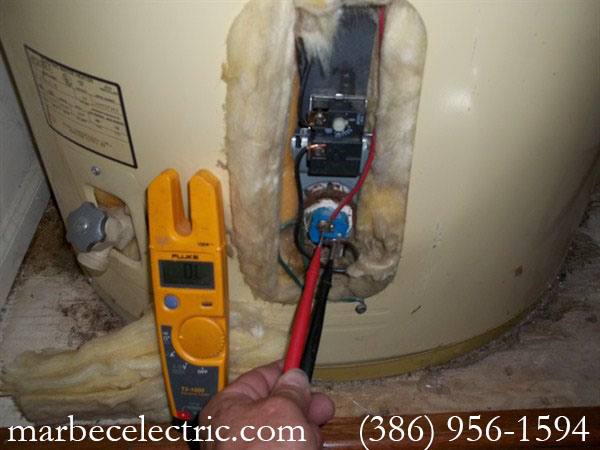
The hot water heater represents one of the greatest hazards in the modern home, yet far too many homeowners have never read their heater’s owner’s manual. Common dangers associated with these household appliances include severe burns from scalding water, electric shock hazards, explosions, and fire.

Because most water heaters reside in closets, basements and garages, and are for the most part hidden from our daily lives, many aren’t as aware as they should be of the maintenance and precautions which are necessary for safety. Many homeowners don’t know for instance, that they should drain and flush a hot water heater every six months, to prevent sediment buildup. Others are unaware that hydrogen gas can build up inside electrically heated hot water systems when they remain inactive for two weeks or more. Hydrogen buildup requires carefully performed procedures to safely remove this flammable gas from hot water pipes. Many don’t know how and why water softening systems shorten the lives of water heaters, or that every electric hot water heater should be properly grounded with the correct gauge of copper wire. Marbec Enterprises can do this.

Correct safety and maintenance measures covered in a water heater’s manual are extremely important for household safety, so every homeowner should study this to learn how to properly maintain their hot water systems. It’s also extremely important to understand the electrical dangers these appliances represent. Because a hot water heater contains electrical heating elements immersed in water, these elements can deteriorate with age and short out electrically to the water heater’s metal casing. When this happens, it’s possible to receive a severe and perhaps fatal shock when touching the hot water heater’s housing or connecting pipes. If you do not have the necessary skills to work safely around high voltage electrical conditions, you should always call a professional electrician at Marbec Enterprises any time you suspect a problem with your hot water heater or when you have any other electrical concerns. When any questions about electrical safety arise, please call Marbec Enterprises. Our electricians are trained and equipped to identify any type of hazardous electrical condition, and to determine the proper repair procedure
s.

Longwood, FL | (386) 956-1594 | marbecelectric.com | twitter.com/MarbecElectric | marbecelectric.tumblr.com | plus.google.com/102338195995648896384/posts?hl=en

Friday, July 22, 2016

LED's More Efficient in Their Consumption of Electrical Energy

Short for “light emitting diode” and introduced commercially in the early 1960’s, the first LEDs produced low levels of red light, and were first used as indicator lights on electronic equipment. As their name suggests, LEDs are diodes, and will operate on both AC and DC electric current. In the mid-seventies, the first digital watches featured LED displays, and in the following decades, LED technology expanded into many applications as LEDs producing most of the light spectrum were developed, from infrared to short wave ultraviolet.

Most notable has been the development of LEDs producing extremely bright “white” light. Although these “white LEDs” first produced very cold bluish white light, their output has become more sophisticated, and LEDs are now available which produce “neutral white” as well as “warm white” light. The latter light color is very pleasing, and quite similar in color temperature to light produced by halogen lamps. Another term for LED lighting is “solid state lighting,” as opposed to “hollow state lighting” which describes nearly every other type of lamp or light bulb. LEDs have seven distinct advantages over halogen lamps, and ten advantages over fluorescent lamps. Smaller in size, quicker in response time, and cooler in operation, LEDs last 100,000 hours or more – longer than both halogen and fluorescent lamps. They are more efficient in their consumption of electrical energy than either halogen or fluorescent lighting, and they are safer than other lighting because LEDs can operate on much lower voltages. Also, because they have no delicate glass envelope or fine wire filaments, they are much more resistant to shock and vibration than halogen and fluorescent lamps. Because of their low voltage operation and resistance to impact and vibration, solid state lighting is rapidly replacing all other forms of RV, truck, marine, aerospace, and automotive lighting.

Very recently, solid state lighting is also appearing in homes and offices. And this is where its additional advantages over fluorescent lamps really shine. First, when operated from a DC power supply, solid state lighting doesn’t flicker like fluorescent lighting, which lends to a much more comfortable environment for individuals sensitive to flickering light. LEDs designed for visible spectrum illumination produce no harmful UV emissions, making them safer for our eyes and for artwork which can fade from exposure to ultraviolet light. Most importantly, LEDs contain none of the hazardous mercury vapor present in all fluorescent lamps, including CFLs (compact fluorescent lamps). Because of the mercury vapor they all contain, fluorescent lamps of all kinds represent a serious and potentially dangerous hazard in our homes, schools, hospitals, public spaces, and offices. They also represent a serious ongoing disaster as we dump literally tons of mercury from discarded fluorescent lamps into our environment every year. So, as prices for LEDs continue to drop, we should all hope to see solid state lighting replace all forms of environmentally hazardous fluorescent lighting. If you are interested in a mercury free home or workspace, please contact Marbec Enterprises.

Longwood, FL | (386) 956-1594 | marbecelectric.com | twitter.com/MarbecElectric | marbecelectric.tumblr.com | plus.google.com/102338195995648896384/posts?hl=en

Thursday, July 21, 2016

AFCIs Have Been Developed & Mandated by Law to Protect Lives & Property From Electrical Fires

As its name implies, an Arc fault Circuit Interrupter is designed to detect electrical arcing, and turn off the current to wiring or appliances where arcing is occurring. An electrical arc occurs anytime an electric current jumps through a gap or airspace between two conductors. This typically produces a visible spark, or sparks. We’re all familiar with small sparks which can be seen inside electric tools and motors, and tiny sparks which may occur when we plug an electrical device into a wall outlet. Small levels of arcing are normal and benign in these places, but dangerous arcing is a different matter. Dangerous levels of arcing can involve damaged insulation, worn or broken conductors, many other electrical problems. This type of arcing is the single greatest cause for electrical fires across our continent, and has resulted in hundreds of human fatalities, hundreds of thousands of fires, and billions of dollars in property damages. AFCI’s are designed to detect dangerous levels of arcing while ignoring benign occurrences. When dangerous arcing occurs, an AFCI will immediately detect this and turn off the electrical current for the affected circuit. If someone tries to reset the AFCI, and it trips again rapidly, this is typically an indicator of a larger problem.

While a GFCI is designed to detect electricity which has become shorted to ground, an AFCI is designed to detect arcing within wiring or electrical devices or appliances. AFCI units look a lot like circuit breakers, and are typically located inside breaker boxes, rather than outlets. However, they are able to detect dangerous arcing conditions a breaker cannot detect. In addition, AFCIs are manufactured for circuits carrying up to 100 amps, so they can protect buildings from arcing in large equipment like stoves and central air units.

AFCIs have been developed and mandated by law to protect lives and property from electrical fires caused by arcing. However, many older homes and buildings have not been retrofitted with these devices and remain unprotected. To make matters worse, older buildings are more likely to have outdated wiring and appliances, and insulation problems and other conditions which cause arcing problems. If you are concerned about your wiring and would like to schedule a safety inspection, call Marbec Enterprises. Our electricians are licensed
and equipped to inspect electrical systems, and can determine if your home or building is sufficiently protected by AFCI protective devices.

Longwood, FL | (386) 956-1594 | marbecelectric.com | twitter.com/MarbecElectric | marbecelectric.tumblr.com | plus.google.com/102338195995648896384/posts?hl=en